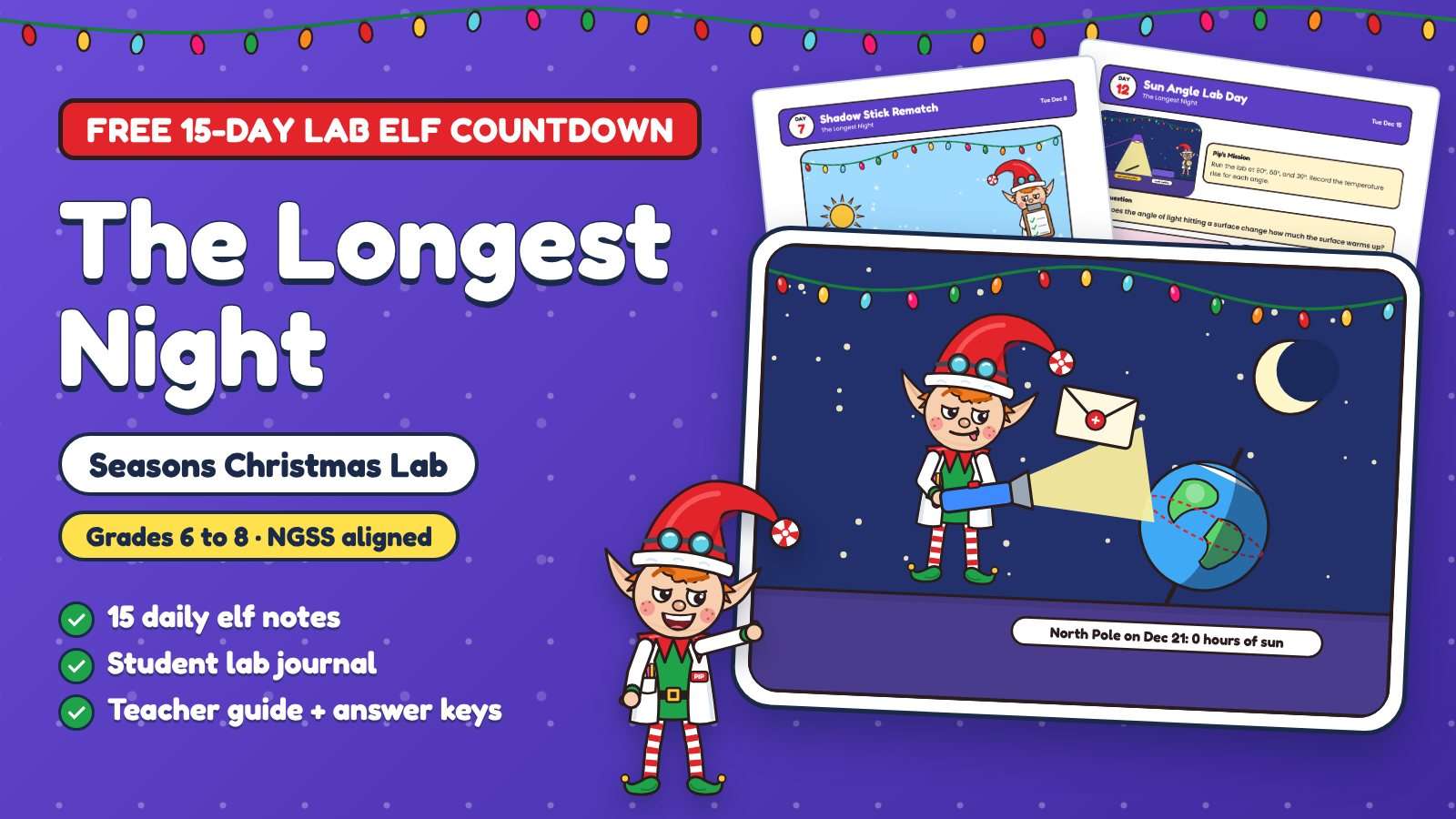
Free seasons lab for middle school: 10 quick December warm-ups on tilt and daylight, then a 5-day sun angle lab. NGSS MS-ESS1-1. Get all 3 PDFs free.


NGSS Science Curriculum for Science Teachers
Below are some of our Free Earth and Space Science Lessons, Labs, and Activities for you to use with your classes. These are full of resources to help you do different types of hands on engaging activities with your students. Our goal is to give teachers their free time back by spending less time planning :)
If you would like access to our Full Earth and Space Science Curriculum then
Free seasons lab for middle school: 10 quick December warm-ups on tilt and daylight, then a 5-day sun angle lab. NGSS MS-ESS1-1. Get all 3 PDFs free.

Climate Change Inquiry Lab The Earth’s climate has changed throughout history. Just in the last 650,000 years, there have been seven cycles of glacial advance and retreat, with the abrupt end of the last ice age about 7,000 years ago marking the beginning of the modern climate era – and of human civilization. Most of […]

Saltwater vs Freshwater Comparison Saltwater and freshwater are constantly mixing and interacting in estuaries. An estuary is an area where a freshwater river or stream meets the ocean. In estuaries, the salty ocean mixes with a freshwater river, resulting in brackish water. Brackish water is somewhat salty, but not as salty as the ocean. Water […]

Modeling the Seasons Earth’s seasons — the annual climate changes that different locations experience — result from a combination of Earth’s orbit around the Sun and the tilt of Earth’s axis. Understanding why the Earth has seasons is one of the most difficult concepts to understand. However, creating models that could demonstrate how different seasons […]

The Planets of Our Solar System Project - Solar System Beads Our Solar System consists of the Sun, the planets and their moons, and other celestial bodies like comets, asteroids, and meteoroids. It is a star system that is immense in size and is held together by a strong gravitational force. The Solar System is […]

Investigating Effervescent Tablets Humans are innately curious. This curiosity allows us to observe, explore, question, and experiment to understand our environment. This curiosity begins when you start “why” and “how” questions which shows the systematic process of thought and investigation referred to as the scientific method. In this simple activity, you will learn the steps […]

Mary Goes to Market – Lab Equipment Names Doing hands-on activities like experiments is one of the best ways to learn science. Conducting experiments help you understand important concepts through direct investigation of a certain chemical reaction and manipulation of various materials. In order to successfully achieve accurate results in experiments, it is necessary to […]

Resource Extraction Simulation Mining is a process of extracting natural resources from the Earth’s crust. Modern mining consists of utilizing machinery to dig for resources which are identified by geologists and geophysicists. Engineers, contractors, governments, and companies then determine the best strategies for extracting these resources. Mining operations often consist of extraction, storage, and transportation […]

Meteorite Impact – Creating Craters Meteorites are space rocks that can survive and fall onto the Earth’s surface. Asteroids and other bodies can hit with immense force that can create craters, sometimes even huge craters. The size and depth of the craters created by an impact vary. The moon for one has millions of craters […]

Cloud in a Bottle Experiment Background Information: Cloud formation is a visually stunning reminder of the complex energy systems at work in the atmosphere. Understanding cloud formation first requires us to remember that air, though primarily composed of nitrogen and oxygen, is also made up of water vapor. The main energy input in this atmospheric […]

How to Make Your Own Volcano! A volcano is a mountain or a hill with an opening where magma is pushed out into the Earth’s surface with immense force. As soon as magma reaches the Earth’s surface, it is called lava. Types of volcanoes can be classified according to the composition and shape of the […]

The Hydrosphere: Our Edible Earth Lab Activity The Subsystems of Earth Earth is the third of eight planets in our solar system, the third planet from the sun, and the only place in the universe known to support life. Our planet earth is a complex, dynamic system comprised of a merger of interacting, interdependent parts […]

Demonstrating Chemical Weathering Rocks are not only changed by water, wind, and ice but can also be changed by chemicals. Chemical weathering is the process by which the actual minerals that rocks are made of are changed. Chemical weathering can cause minerals to decompose and even dissolved. Examples of chemical weathering include how acid rain […]

Investigating Evidence for Mass Extinctions Lab Animals and plants disappear all the time as extinction is a natural part of life. About 98% of all the organisms that have ever existed on our planet our now extinct. When a species goes extinct, its role in the ecosystem is usually filled by new species, or other […]

Moon Impact Craters Lab Activity - Part 1 In this activity, you will create impact craters in plaster of Paris. Moon Impact Craters Lab Supplies Needed per student or group: Prepared plaster of Paris OR dry plaster, water and a container Projectiles Tempura paint and sifter (your teacher may substitute a different powdered medium) Meter […]

The Sun Wants Us Closer Lab - The Sun's Gravitational Pull In everyday language, gravity is defined as the force that pulls everything down toward the surface of the Earth. It proves the old saying that “what goes up, must come down.” It can be felt and experienced on a daily basis. For instance, people […]

Best Stain Remover Lab - Writing Up an Investigation Many brands of liquid detergent are sold in the groceries. Each brand claims that it is the best when it comes to stain removal. But which one is really the best? You will find out in this laboratory activity which involves planning, conducting, and writing up […]